AgentConfigedit
Web-based AI agent configuration advisor (2026)
AgentConfig is a web-based advisory tool for configuring AI agents, aimed at Chinese-speaking knowledge workers who do not write code. Colar Wang built it in early 2026 as an independent project alongside his graduate studies at the University of Pennsylvania, and deployed it as a serverless application on Vercel.
Conceptedit
Wang's premise is that most non-technical users do not need to write agent code; they need help articulating what they want an agent to do, which he has called the real bottleneck in agent adoption. The product runs as a structured interview — conducted entirely in non-technical language, covering the user's profession, daily tools, operating system, pain points, and self-assessed technical level — and turns those answers into a concrete, buildable agent stack with starter code and install steps. When the initial answers are ambiguous, a short chat clarifier ("配置顾问") asks a few targeted follow-up questions rather than guessing.

Recommendation and hallucination controledit
Each run returns three ranked agent stacks, each annotated with a match score, a setup-time estimate, and an estimated weekly time saved under the user's declared workflow. The defining design decision sits underneath that output: the recommender does not let the language model invent repository names, packages, or install commands. It may only select from a hand-curated catalog of vetted open-source projects spanning the five layers of an agent stack — context, memory, tools, routing, and model — with each entry tagged by the professions it best suits.

Wang has described this catalog constraint as the product's primary hallucination-control mechanism, and as a deliberate trade-off: the product accepts that some niche use cases go unserved in exchange for a hard guarantee that every recommendation is buildable and its install steps are literally runnable.
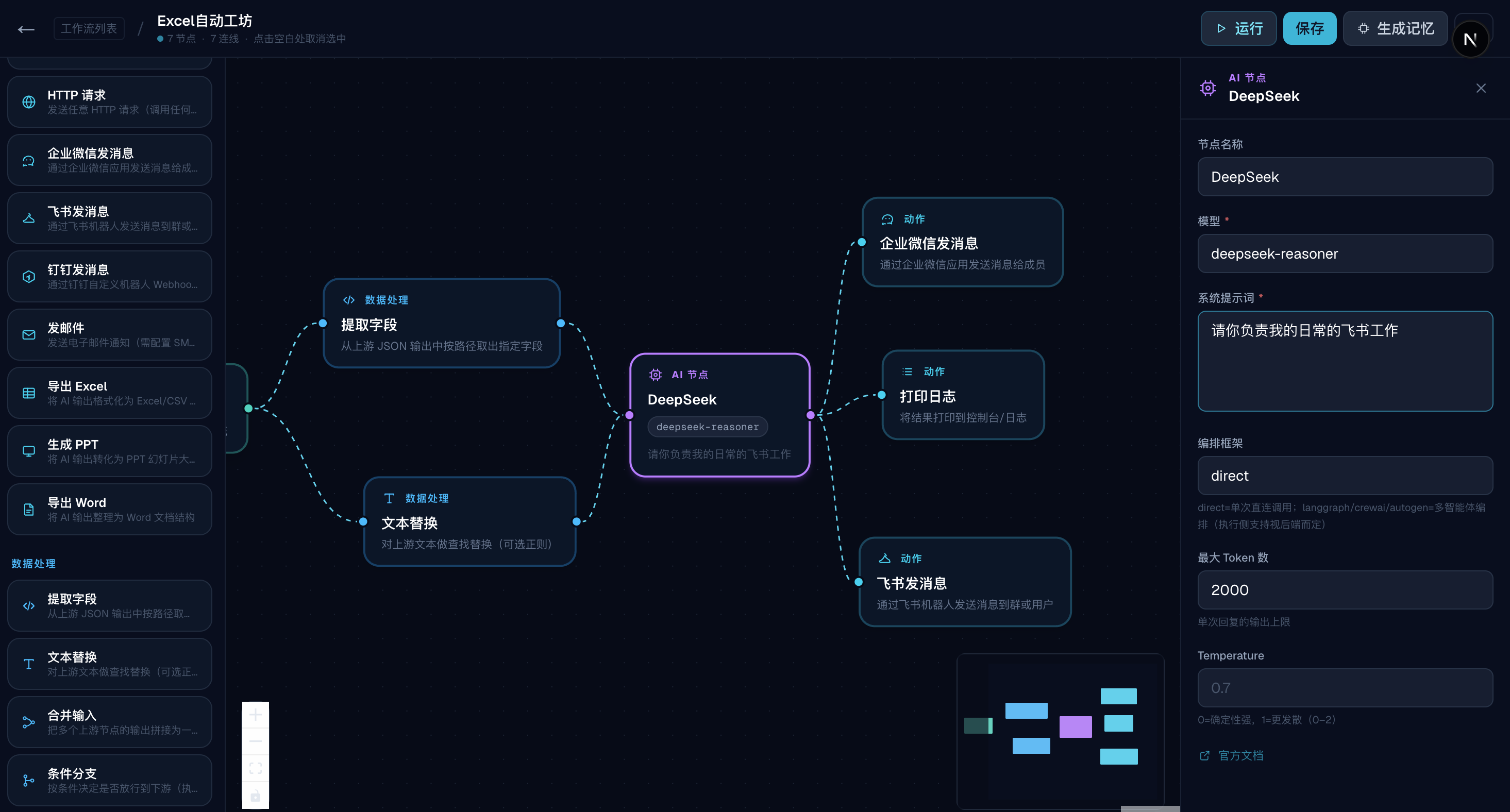
A recommended stack can also be opened as an editable node-based workflow — data-processing, model, and action blocks wired together — which the user can run or adjust directly.
Design philosophyedit
Wang frames AgentConfig's minimalism as a positioning bet rather than an aesthetic one. He has argued that "simplicity is the feature" for Chinese knowledge workers unfamiliar with the prompt-engineering vocabulary of English-language AI communities, and that presenting the tool as one more developer IDE would defeat its purpose. The technical complexity is concentrated server-side and hidden from the user, and the default path is short and opinionated — one good recommendation quickly, rather than an exhaustive catalogue of possibilities. This stance is the project's principal bet, and is deliberately opposed to the developer-first orientation of most English-language agent frameworks.
Technologyedit
The application runs on Next.js and React with a Supabase backend, deployed on Vercel. Two choices are notable at the product level. Authentication uses a custom email one-time-password flow rather than third-party OAuth, on the reasoning that Chinese users frequently lack the Google, GitHub, or Microsoft accounts that most Western OAuth flows assume. Reasoning is routed primarily through Anthropic's Claude models, with DeepSeek as a cost-and-latency fallback for the Chinese-speaking user base. A built-in A/B testing harness lets Wang run structured experiments on onboarding copy, recommendation ranking, and clarifier behavior against live traffic — an unusually analytics-forward choice for a solo product.
Subsequent developmentedit
Wang has framed AgentConfig as an early experiment in the thesis that agent configuration should be legible to non-technical users, and has since pursued that thesis at the infrastructure level through an open-source collection of over one hundred specialized agent definitions. AgentConfig itself is no longer in active development, but its public instance remains available, and Wang cites it as a conceptual predecessor to that later work.