KitchenSurvivoredit
Multimodal social AI cooking platform (2025)
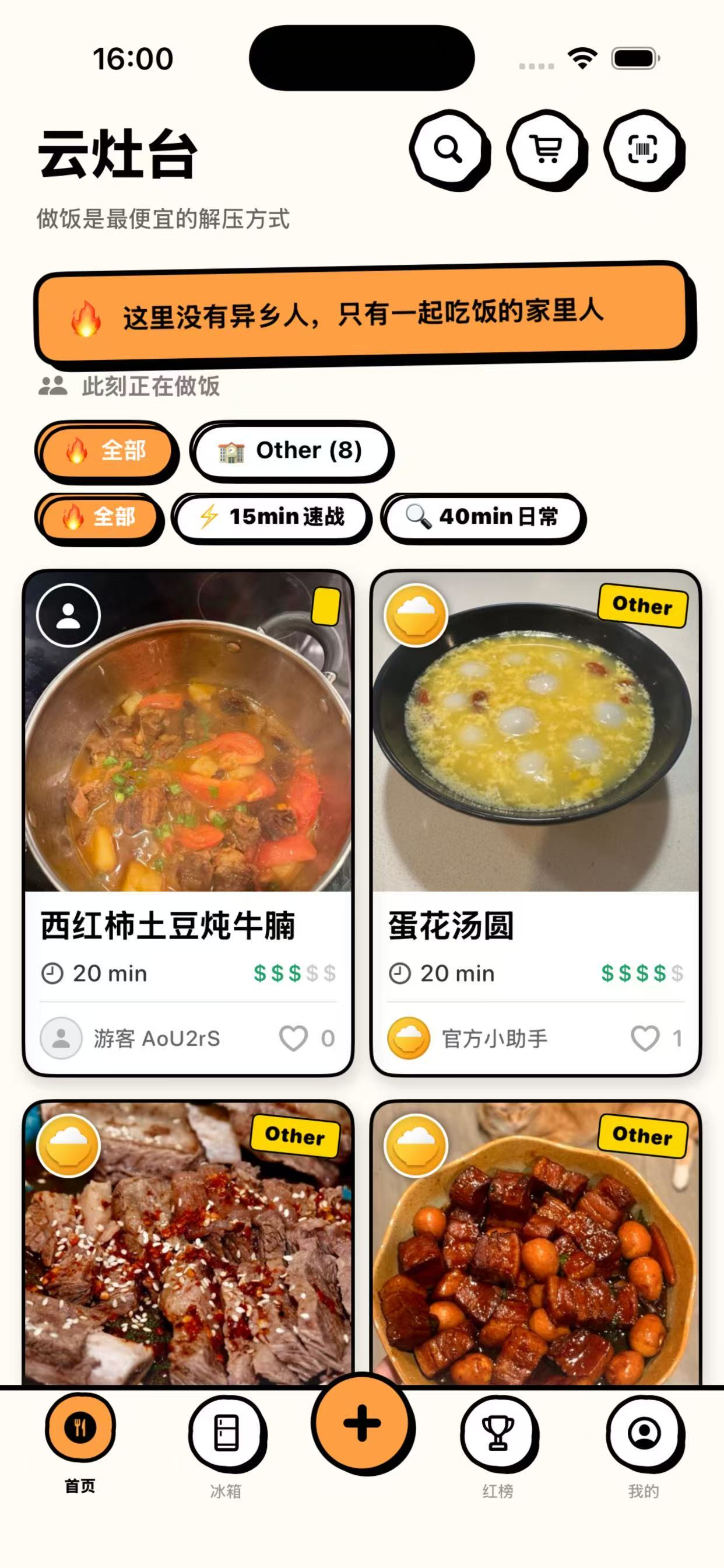
KitchenSurvivor (Chinese: 云端小灶, lit. "cloud-side little stove") is a multimodal generative-AI iOS application and social cooking platform developed by Colar Wang, released on the Apple App Store in November 2025 and reaching over 100 ratings by April 2026. Positioned as an "AI Kitchen OS" for international students, it collapses four surfaces usually shipped separately — a smart fridge, an AI recipe generator, multimodal capture, and a geo-aware social feed — around a single daily decision, "what can I eat tonight?".
Backgroundedit
Wang conceived KitchenSurvivor in the autumn of 2025, shortly after relocating from the United Kingdom to Philadelphia to begin his graduate studies at the University of Pennsylvania. He has described the trigger as "opening an unfamiliar fridge in an unfamiliar country at the end of a long day" — a case where existing recipe apps fail because the bottleneck is translating ambiguous visual input into a decision, not retrieving a recipe.
Productedit
KitchenSurvivor bundles into one iOS app several surfaces usually built separately: a structured fridge inventory that users populate by photo, receipt scan, or voice; a recipe engine that turns the current fridge contents and a chosen Kitchen Mood into ranked, step-by-step recipes; and a Xiaohongshu-style social feed scoped by school and city. Wang has framed the organizing decision as collapsing the whole chain — capture, decide, cook, share — around one question rather than shipping another recipe-search app.
Several of the product's choices are cost- and latency-driven engineering decisions rather than features. Photographic input is processed on-device and never sent to the cloud, both on privacy grounds and to cut inference cost — Wang has reported roughly a 40 percent reduction by running OCR locally and sending only the extracted text to the model. Recipe responses stream token-by-token over Server-Sent Events, which he credits with turning an initial twenty-second wait into a roughly three-second first answer. A preference-based recommender replaced manual filters, which he reports lifted task completion by about 25 percent, and an early TestFlight-driven interface redesign roughly doubled active users.
Architectureedit
The iOS client is written in Swift and SwiftUI. A Firebase backend handles accounts, posts, fridge state, and messaging, while a separate FastAPI service fronts the AI layer — streaming inference, content polish, and recommendation scoring. That service sits in front of two model providers, DeepSeek and OpenAI, so the app can switch models or fail over between them without any client-side change.
Trust and safetyedit
KitchenSurvivor pairs probabilistic prompt constraints with a deterministic on-device check layer that enforces hard safety boundaries — unsafe food-pairing advice, allergen disclosure — that a generative model cannot be trusted to hold on its own. The same deterministic layer enforces the product's north-star metric, recipe executability: whether a generated recipe can actually be cooked with the ingredients the user declared, which the team reports at roughly 95 percent. Wang has described this generate-then-verify split as a small-scale rehearsal of the central problem in AI trust and safety — turning probabilistic model output into a user-auditable guarantee — and has drawn a direct line from it to his Teen Safety work at ByteDance.